In short the fundamental reason why a honeycomb substructure is useful is because it retains two key benefits: (1) xy isotropy, and (2) material continuity on the z-axis. There is no popularly-known infill pattern that can do this anywhere as efficiently. Material isotropy refers to the directional dependence of the mechanical properties of the part. FFF-manufactured parts are intrinsically very anisotropic (not isotropic) on the z-axis due to it's reliance layer adhesion in this direction (and there's not a whole lot we can do about this). You can visualize this by a long slender beam; if you print it lying down on the bed, it will hold significantly more bending load than if you print it standing up. In the xy plane however, 3d printed parts are usually quite isotropic, as long as the infill geometry is symmetric. Hatched linear infill (what S3D uses) isn't symmetric on a single layer, but because it reverses direction each layer, From a net standpoint, it's more or less symmetric (this is good). The problem with hatched infill (linear or not) comes from material continuity in the z-direction.
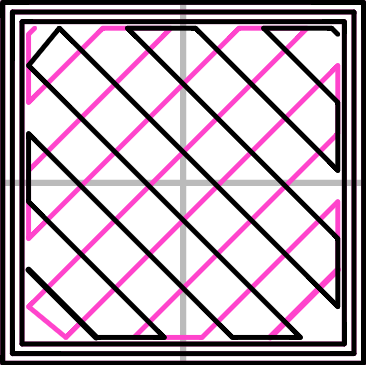
This is an example of hatched infill. You can see that as the part builds along the z-axis, the only points where the infill retains material continuity are at the intersection points between the two layers. This results in an order of magnitude of less adhesion between layers, making the z-axis extremely weak against tensile loads (exacerbating the original issue of part anisotropy), as well as proving significantly less moment of interia to resist bending and torsion loads. Conversely, a honeycomb infill solves both of these problems because it's intrinsically a symmetric pattern, thereby retaining xy isotropy, and providing z-axis material continuity for all of the infill material (see below).
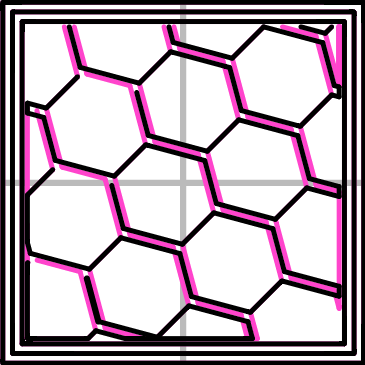
The drawback with honeycombed infill is that that its slightly slower than a linear infill since it moves in a zig-zag line instead of a straight line. As with any engineering project (or manufacturing method) we're constantly managing three budgets: time, cost, and performance. Honeycombed infill provides a technological option that trades off time for decreased cost (less material for same strength) and/or increased performance (same material cost for more strength). This is an option that really needs to be offered, especially if you envision S3D as a software solution for high performance FFF-manufactured parts.
For more background reading see this link (which I also credit the pictures I posted): http://manual.slic3r.org/expert-mode/infill
